
Regular readers of Linda’s Book Bag will know that I have been trying not to take on blog tours this year. I have done some, of favourite authors, or when I knew life wouldn’t be too busy, or when I have been approached personally by an author. If I say that I actually offered to be part of the blog tour for Barbara Henderson’s latest work for young readers, Black Water, you’ll appreciate just how special a writer I think she is!
Today, as well as sharing my review I’m delighted that Barbara returns with a super guest post considering the Novel versus Novella!
You can see the other occasions I’ve featured Barbara here on Linda’s Book Bag through the following links:
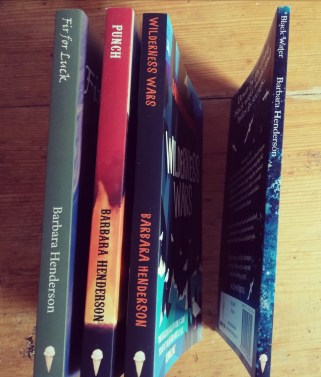
My review of Fir For Luck here (also one of my books of the year in 2016).
A smashing guest post from Barbara about Fir For Luck publication day here.
Another super post about why a book launch matters to celebrate Punch here.
A guest post about nature and my review of Wilderness Wars here.
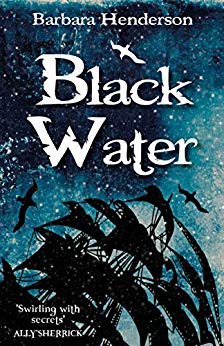
Published on 31st October by Cranachan imprint, Pokey Hat, Black Water is available for purchase here.
Black Water
Down by the coast, black water swirls and hides its secrets…
Dumfries, 1792. Henry may only be thirteen, but he has already begun his training in the Excise, combatting smuggling like his father does. But when a large smuggling schooner is stranded nearby, the stakes are high—even with reinforcements, and the newly recruited officer, a poet called Robert Burns.
Musket fire, obstructive locals, quicksand and cannonballs—it is a mission of survival. As it turns out: Henry has a crucial part to play…
Novel versus Novella
A Guest Post by Barbara Henderson
I’m a writer. More specifically, I’m a writer of novels for young people. I thought that was fairly straightforward.
One thing I have in common with Linda is that I, too, worked as an English teacher in secondary schools where pupils studied poems, plays and yes, novels again.
So, imagine my surprise when I ran my new idea for an 18th century smuggling novel past my publishers, Cranachan (one of the many great things about this small independent wee publisher in Scotland is that Anne Glennie, the editor of my books, has considerable expertise in educational matters): ‘You don’t want a novel here, Barbara,’ she said.
Why ever not? The unspoken question hung in the air.
‘Think about it!’ she urged. ‘Schools come back after Christmas. They do projects on Burns until Burns’ Day on the 25th of January.’
I was always a bit slow on the uptake. As my brain’s cogs were turning, she spelled it out some more. ‘We need this book short, you see – so that schools can fit it in. Not a novel. More like a novella.’
Well, here was a challenge: condensing what I really wanted to say into a novella – not 40 000 words, more like 13 000, and preferably less. Well, I might as well make those words good ones! I set to work, and found that, actually, the core events I was describing only took place over a couple of days. This story, at its heart, had perhaps always been a novella, before I even attempted to make it one.
There are other brilliant short books out there. Neil Gaiman’s Coraline, Ted Hughes’ The Iron Man, and of course, Stig of the Dump – all fit the novella format. I was in good company as a novella writer – especially when you also consider Theodor Storm, the German master of the genre. I love his work, and his brooding and atmospheric coastal locations probably influenced Black Water more than I was aware of at the time.
I enjoyed writing the first draft immensely – half a month and I was nearly there. The editing and fixing took a little longer – but essentially, it was a much more achievable task than writing and researching a full-length novel.
So here I am, pushing Black Water out into the book trade surf. Sink or swim, little book – you’re about to sail alongside the big guys. Hold your own, wee book, don’t let anyone mess you about! Ride the wave and enjoy it!
I can assure you, Barbara, that Black Water will swim and swim. Here are my thoughts:
My Review of Black Water
Thirteen year old Henry shadows his father on Excise duty in the late 1700s.
Black Water may only be a short novella but it packs a powerful punch. Steeped in history, intrigue and fast-paced drama this is a story that thrills at every turn.
Barbara Henderson’s writing style is sheer perfection because it is authentic for the period, especially in direct speech, and yet it remains completely accessible to the target audience of 8 to 10 year olds. With a glossary at the end, any potentially unfamiliar vocabulary is simply explained, making Black Water an educational as well as an exciting book. Shamefully, I had no idea that the poet Robert Burns had been an Exciseman and the addition of some of his poetry, the author’s note and extracts from the real Crawford’s diary give Black Water added interest and potential. It makes me wish I were back teaching so that I could explore its historical elements, the poems of Burns and the art of diary writing with my young students.
Having acknowledged the educational potential of Black Water, however, I have to emphasise that its greatest attraction is in being a cracking story. I loved the fact that the Excisemen are the heroes rather than the traditional smugglers. The exploration of loyalty, friendship, family and truth give so much to think about even as the narrative is enjoyed simply as an exciting historical drama.
The descriptions are stunning so that I could place myself alongside Henry on the shoreline and I thought the illustrations that accompany the writing added wonderful atmosphere. Henry’s first person voice is clear and effective making him the true hero of the story despite his age and I’d love to read more about him in future.
Black Water confirms for me what I already knew. Barbara Henderson is a master storyteller and one of the best writers for youngsters around. Black Water is another winner of a book and I recommend it completely – to all ages!
About Barbara Henderson
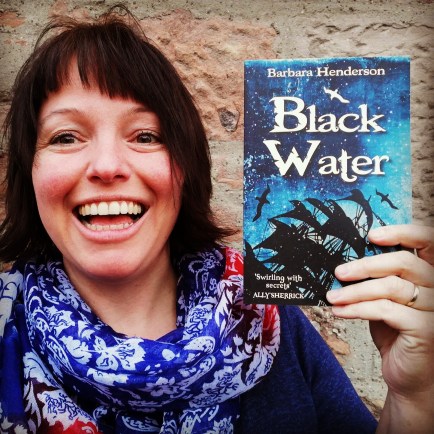
Barbara Henderson has lived in Scotland since 1991, somehow acquiring an MA in English Language and Literature, a husband, three children and a shaggy dog along the way. Having tried her hand at working as a puppeteer, relief librarian and receptionist, she now teaches Drama part-time at secondary school.
Writing predominantly for children, Barbara won the Nairn Festival Short Story Competition in 2012, the Creative Scotland Easter Monologue Competition in 2013 and was one of three writers shortlisted for the Kelpies Prize 2013. In 2015, wins include the US-based Pockets Magazine Fiction Contest and the Ballantrae Smuggler’s Story Competition.
Follow Barbara on Twitter @scattyscribbler for more information, or and read her blog. You’ll also find her author page on Facebook.
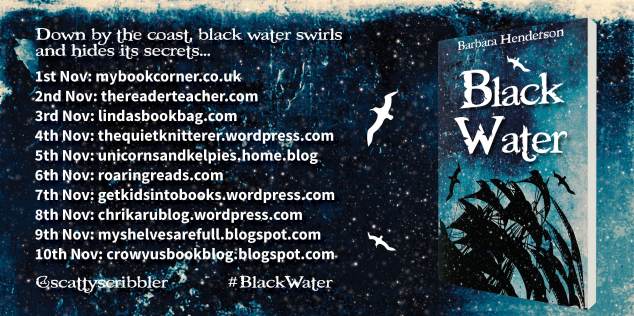
There’s more with these other bloggers too:

 Linda's Book Bag